AI & AI Education
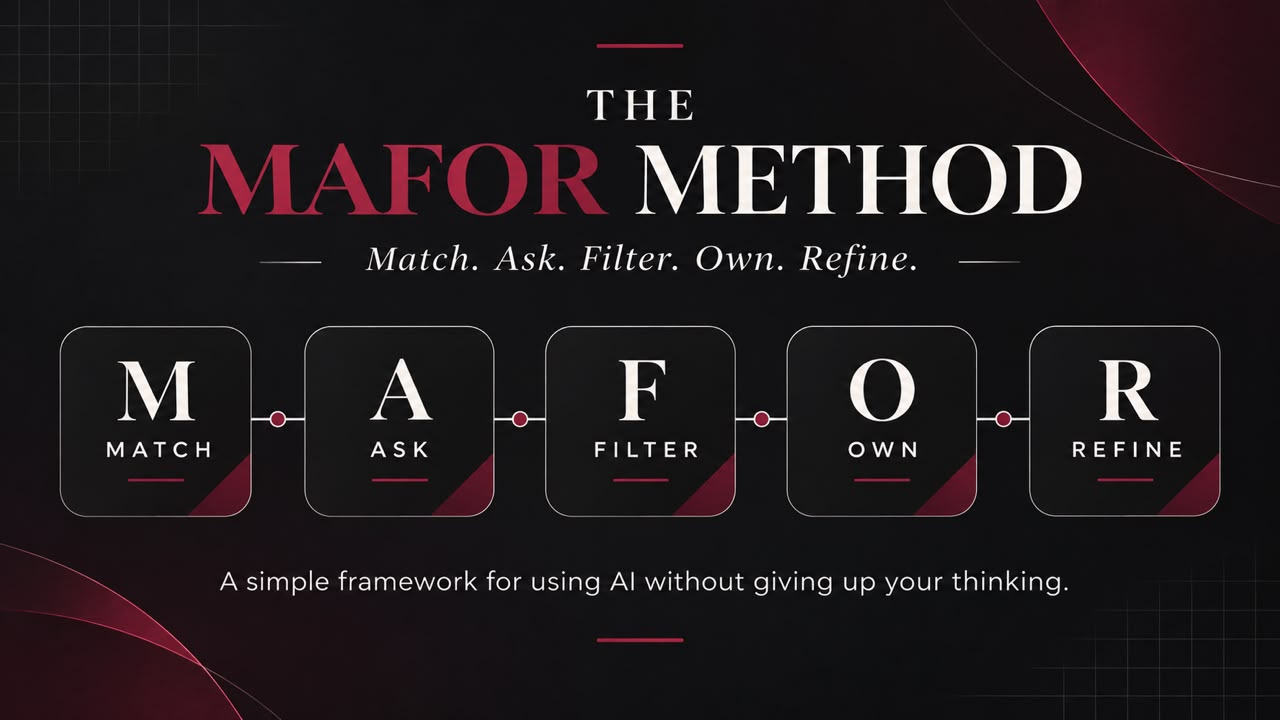
The MAFOR Method: A Simple Framework for Using AI Without Giving Up Your Thinking
Artificial intelligence is becoming easier to use. That is both its strength and one of its biggest risks.
Today, almost anyone can open an AI tool, type a question, and receive a polished answer within seconds. We are learning how to write better prompts, generate content faster, conduct research, organise our work, brainstorm ideas, and solve problems with AI.
But I believe there is a more important question we need to ask:
Are we learning how to use AI, or are we simply learning how to ask it for things?
Prompting matters. But prompting alone is not AI literacy.
Knowing how to communicate with an AI system does not automatically mean knowing when to use it, how to evaluate what it produces, when to challenge it, or when to rely on your own judgment.
That distinction became increasingly important to me through my work teaching people how to use artificial intelligence.
I noticed that many people approach AI as though it were an obedient machine that simply needs the right command:
“Write this for me.”
“Tell me what to do.”
“Give me the answer.”
“Make the decision.”
The problem is not simply that those prompts can produce weak results.
The deeper problem is that we can slowly begin to outsource the thinking itself.
That is what led me to develop what I call The MAFOR Method.
It is a simple five-step framework for using AI more deliberately:
Match. Ask. Filter. Own. Refine.
The goal is not to make AI complicated.
It is actually the opposite.
The MAFOR Method gives you a simple mental checklist for using AI while keeping your own thinking involved.
M — Match the Task
Before opening an AI tool, ask yourself:
What am I actually trying to do?
And then:
Is AI the right tool for this task?
We often begin with the tool instead of the problem.
Someone discovers ChatGPT and suddenly every problem becomes a ChatGPT problem.
But different tasks require different approaches.
You may need AI to:
- brainstorm ideas
- summarise information
- analyse a document
- explain a difficult concept
- improve your writing
- organise your thoughts
- research a topic
- generate images
- help with code
- plan a project
Those are very different tasks.
And sometimes AI should not be the primary tool at all.
If you need verified current information, specialist professional advice, confidential decision-making, or authoritative evidence, you may need other sources or human expertise alongside AI.
The first step therefore happens before the prompt.
Understand the task.
Then decide how AI should fit into it.
A — Ask Clearly
Once you know what you need, communicate it properly.
This is where prompting comes in.
A weak prompt often produces a weak result because the AI has very little information about what you are actually trying to accomplish.
Compare:
“Write me a marketing strategy.”
with:
“I run a small fashion business targeting women between 25 and 40. Most of my sales currently come through Instagram and WhatsApp. My goal is to increase enquiries over the next three months without significantly increasing my advertising budget. Help me identify three practical digital strategies, explain the reasoning behind each one, and tell me what I should measure.”
The second request gives the AI:
- the task
- the context
- the audience
- the objective
- the constraint
- the expected output
Good prompting is not about finding magical words.
It is about giving the system enough useful information to understand what you need.
But this is also where many AI lessons stop.
The MAFOR Method does not.
Because receiving an answer is not the end of the process.
F — Filter the Answer
This may be one of the most important AI habits to develop.
Do not accept an AI response simply because it sounds convincing.
AI systems can produce fluent, structured, confident answers that are incomplete, misleading, unsupported, or simply wrong.
They can also be influenced by the way you frame your question.
If you strongly suggest a conclusion in your prompt, the AI may reinforce your thinking rather than challenge it.
So when you receive an answer, filter it.
Ask yourself:
- Does this actually answer my question?
- What assumptions is the AI making?
- Is anything missing?
- Is it agreeing with me too easily?
- Are there claims that need verification?
- Does the reasoning make sense?
- Is this specific to my situation or just generic advice?
- Could my prompt have pushed the answer in a particular direction?
This is particularly important when dealing with facts, statistics, research, health information, legal matters, financial decisions, or anything else where being wrong has meaningful consequences.
AI can help you think.
It should not make you stop thinking.
O — Own the Decision
This is the part I believe we risk losing if we become too dependent on artificial intelligence.
You still have to own the decision.
AI can suggest.
AI can analyse.
AI can compare options.
AI can challenge assumptions.
AI can help you see possibilities you may have missed.
But there are decisions that remain yours.
If you ask AI whether you should leave your job, end a relationship, invest money, choose a career, publish an argument, or make an important business decision, the final responsibility does not transfer to the machine.
You know things the AI does not know.
You understand your values.
You experience the consequences.
You carry the responsibility.
Using AI intelligently therefore requires knowing the difference between:
“AI helped me think through this.”
and
“AI decided this for me.”
Those are not the same thing.
The goal should be assistance, not surrender.
R — Refine the Result
The first answer does not have to be the final answer.
Use AI iteratively.
Challenge the output.
Ask follow-up questions.
Correct wrong assumptions.
Provide missing information.
Request another perspective.
Verify important claims.
Rewrite parts that do not sound like you.
Add your own experience and expertise.
Refining is where AI becomes collaborative rather than merely transactional.
For example, instead of accepting a business strategy immediately, you could respond:
“Three of these recommendations assume I have a large marketing budget. I do not. Rework the strategy for a small business with limited resources.”
Or:
“You have supported my position throughout this conversation. Now argue against my idea as strongly as possible and identify what I may be overlooking.”
That second interaction may be far more valuable than the first answer.
AI becomes more useful when you stop treating its initial response as a finished product.
The MAFOR Method in One Line
The framework can be remembered simply as:
MATCH → ASK → FILTER → OWN → REFINE
Match
Choose the right task and decide whether AI belongs in it.
Ask
Give AI clear instructions and useful context.
Filter
Question the answer instead of accepting it automatically.
Own
Keep responsibility for your thinking and decisions.
Refine
Improve, verify, challenge, and personalise the result.
Why This Goes Beyond Prompting
Prompt engineering is useful.
But notice where prompting appears in the MAFOR Method.
It is only one step:
A — Ask.
Before the prompt comes Match.
After the prompt come Filter, Own, and Refine.
That is why I believe AI education needs to move beyond teaching people how to construct better instructions.
The real skill is learning how to manage the entire interaction.
We should be teaching people not only:
“How do I get AI to give me a better answer?”
but also:
“Should I be asking AI this?”
“Can I trust this answer?”
“What is missing?”
“What should I verify?”
“What decision still belongs to me?”
Those questions are part of AI literacy too.
A Simple Example
Imagine someone asks an AI system:
“Should I quit my job?”
Using the MAFOR Method:
Match
Recognise that this is a complex personal decision. AI may help organise your thinking, but it should not make the decision.
Ask
Instead of asking for a yes-or-no answer, provide context and ask the AI to help identify risks, assumptions, alternatives, and questions you need to answer.
Filter
Examine whether the AI is making assumptions about your finances, career opportunities, employer, responsibilities, or personal circumstances.
Own
You make the decision. The consequences belong to you, not the AI.
Refine
Continue the conversation, gather real information, speak to relevant people, verify your options, and update your thinking.
The same five steps can be applied to research, business, education, content creation, planning, and many everyday uses of AI.
The Principle Behind the Method
The MAFOR Method is built around one simple principle:
Use AI to strengthen your thinking, not replace it.
Artificial intelligence can be an extraordinary tool.
But the quality of our relationship with AI will depend partly on whether we remain active participants in the thinking process.
Learning how to prompt is useful.
Learning how to think while using AI is more important.
And that is the purpose of the MAFOR Method.
Match. Ask. Filter. Own. Refine.
Not to make AI harder to use.
But to help us use it better.
Keep Reading
More Insights

AI & AI Education
Building AI in Cameroon: How Local Context Changes What We Design
Building AI in Cameroon requires more than localization. Explore how connectivity, electricity, language, cost, devices, data and payments change AI product design.
AI & AI Education
LLM Evaluation Explained: How to Test AI for Accuracy, Hallucinations, Reliability and Cost
Learn how LLM evaluation works, including accuracy, hallucination testing, reliability, human evaluation, LLM-as-a-judge, RAG evals, latency and cost.